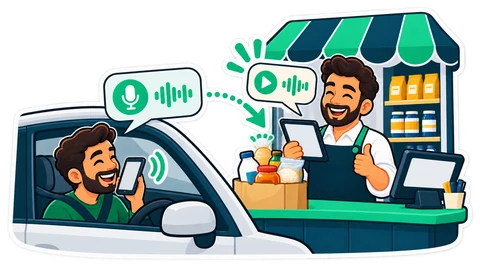
In the UAE an order is as likely to arrive as a voice note or a photo as in typed words. Here is what the AI Front Desk does with each, and how it asks instead of guessing when something is unclear.
Imagine a family grocery with two branches, one in Sharjah and one in Ajman. Look at its WhatsApp on any evening. A 40-second voice note recorded in the car, with the radio on: half Arabic, half English, two product names and "the usual bread". A photo of a handwritten list on the back of an envelope, in Malayalam and English. A photo of an empty jar with the words "same one, 2 please". A message in Urdu asking whether the delivery can come after 9.
Typed, tidy orders are the exception. Whoever answers the shop's phone spends the evening playing voice notes twice and zooming into photos. This is the part of WhatsApp ordering the AI Front Desk was built for.
Voice notes: written down, then checked
When a customer sends a voice note, the Front Desk has it transcribed: turned into text, with a hint of the customer's language and your own product names, so a brand of water or basmati comes out spelled the way your catalogue spells it. The audio itself is never kept, only the words.
What happens next depends on how clear the recording was:
- Clear: the words are treated like a typed message. The assistant searches your catalogue, checks stock and prices, and proposes the order.
- Not quite clear: the assistant must read back what it understood before it proposes anything. "You'd like two bags of basmati 5 kg and one tahini, is that right?"
- Unclear, such as wind, traffic or a mostly empty recording: no action at all. The customer gets a reply such as "I heard «…». Did you mean Tahini 450 g? If not, could you type it or send it again?", with the closest names from your catalogue when there are any.
Either way, nothing is ordered until the customer reads the quote and says yes. Your team sees the transcript of every voice note in the Front desk inbox, so they can follow the conversation without pressing play.
Photos: from a picture to order lines
A photo reaches the AI as a picture, and what it does depends on what is in it:
- A product, such as an empty jar, a box or a shelf label: it searches your catalogue for the match and proposes it, and asks when it is not sure which one.
- A list, handwritten or printed: it reads the lines, finds each item in your catalogue, and proposes an order with the quantities, then asks about anything it could not match.
- Anything else: it describes what it sees and asks what the customer would like.
A location pin works too: the assistant can use it as the delivery address. Pictures are kept with the conversation, so your team sees exactly what the customer sent.
Many languages, one chat
Customers write the way they speak: Gulf or other Arabic, English, Hindi, Urdu, Malayalam, Bengali, Arabic in Latin letters, Hinglish, sometimes all of them in one message. The assistant replies in the customer's own language and keeps the short WhatsApp style. Your catalogue stays as it is; the assistant does the matching.
Bookings by chat, for salons
The same assistant takes bookings when you use CreekPOS Bookings. Picture a salon in Al Barsha. A customer writes, or says in a voice note: "Haircut and blow-dry on Thursday, after five?" The assistant looks at the free start times for that service and day, offers one or two, and holds the chosen slot for ten minutes while the customer confirms. Their yes confirms the booking; your own Bookings setting decides whether it is confirmed straight away or arrives as a request for you to accept.
Good to know
- Voice notes up to three minutes and pictures up to 5 MB are taken.
- Pictures are stored in your shop's own picture storage. If it is full, the customer is asked to describe the item in words instead.
- Messages, transcripts and pictures are kept 90 days. Voice notes go to a transcription service, and pictures to the AI provider named in the privacy policy; neither is used for training under the API terms.
- Orders need the online shop switched on; bookings need Bookings.
What it does not do
It never guesses its way into an order: an unclear voice note gets a question, not a basket. It does not keep recordings. It does not invent a product to match a photo: if the item is not in your catalogue, it says so or hands the chat to your team.
The AI Front Desk is an add-on of the Online Restaurant and Chain plans (coming soon); it costs AED 99 a month before VAT. Read more about voice notes and photos on the AI Front Desk page.
This article is general information as of its date, not legal or tax advice. Rules change; check the official source or ask your accountant before acting.