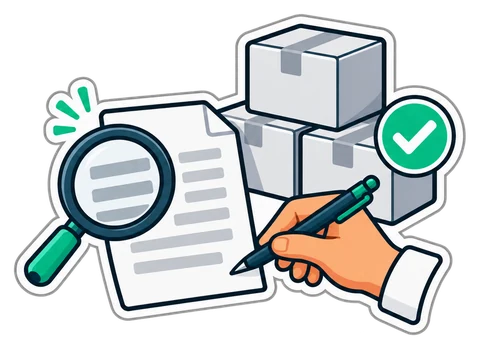
A supplier's invoice that bills ten cartons when nine arrived, or a price a little higher than agreed, costs real money over a year. The three-way match checks each invoice against the purchase order and the delivery note before it is booked, and holds the ones that differ.
A trading company in Jebel Ali supplies cafeterias with cups, lids and napkins. It buys from a dozen suppliers, and its accountant enters their invoices at the end of the month. Nobody compares them with what was ordered or what arrived: the invoice says so, so it is paid. Small differences slip through: a price two percent above the quote, a carton billed that was refused at the door.
Three documents, one check
Accountants call it the three-way match: before paying, compare three documents.
- The purchase order: what you asked for, at what price.
- The delivery note: what actually arrived and was accepted.
- The supplier's invoice: what you are asked to pay.
With Procurement in CreekPOS Online, all three are in the same place, so the comparison is done for you.
At the door: the delivery note
When the goods arrive, receive them against the order with a delivery note. For each line, type what was delivered and what was damaged and refused at the door. Refused goods never enter stock. CreekPOS works out what was accepted and anything over or short, takes the batch and expiry, and records how late the delivery was. A partial delivery is fine: the order stays open for the rest.
The invoice: typed or from a photo
Then record the supplier's invoice. Its lines start from the delivery note, or fill them from a photo with the AI invoice reader, which reads the products, quantities and prices printed on the paper. That reading is the only AI in the process; the comparison itself is exact arithmetic.
Within tolerance: booked
CreekPOS compares each line: the price billed against the order's price, the quantity billed against what was accepted. By default a price may differ by 1 % and a quantity not at all; both tolerances are yours to set.
If everything is within tolerance, the invoice is posted. With Books on, it becomes a bill with the right VAT code and a due date from the supplier's payment terms, so your bills list, the aged payables and the cash forecast all see it. Without Books, the supplier's account takes the difference so its balance is what the invoice says. The same supplier invoice number twice is refused.
Outside tolerance: Invoices to check
An invoice that does not match waits in Invoices to check, with the differences shown line by line. You decide:
- Accept it as it is, with a note (the supplier agreed a new price, say);
- Dispute it: you have asked the supplier, and it stays in the list;
- Return the goods to the supplier;
- Match again once the corrected invoice or the rest of the delivery arrives.
The owner gets an alert for each invoice that did not match, and the daily summary counts what is waiting.
And the suppliers' record
Every delivery and invoice feeds two views: supplier ageing (what you owe each supplier, not due, 1–30, 31–60, 61–90 and over 90 days) and a scorecard per supplier: deliveries on time, the fill rate, prices against the orders, damaged goods. Next time you choose a supplier, you choose on facts.
The three-way match is part of Procurement: included in Online Restaurant and Chain, and an add-on for Online Retail at AED 49 a month before VAT. Read the ERP page and the manual section.
This article is general information as of its date, not legal or tax advice. Rules change; check the official source or ask your accountant before acting.