

Promotions that pay — buy X get Y, bundles and off-peak offers
Before you run a discount, work out how many extra sales it needs to pay for itself. Promotion types, worked numbers and a checklist for UAE shops and cafés.
Small counter discounts add up fast. How much a discount really costs, where it leaks, and how a cap per role with quick manager approval keeps your margin intact.
Discounts are a normal part of selling: a regular who takes a whole carton, a dented tin, a customer who waited too long for a sandwich. The problem is not discounts themselves but the ones nobody actually decided on. A clear cap per role, a quick approval above it and a weekly look at the numbers stop small discounts from quietly eating your margin.
A discount comes straight out of profit, not out of the price. On a low-margin product, a small percentage off removes a large share of what you earn on it.
Take an item that sells for AED 100 and costs you AED 80, a 20% gross margin, typical of a grocery line. Then take AED 100 of café drinks that cost AED 35 in ingredients, a 65% margin. These are round examples, not statistics, and VAT is left out to keep the arithmetic clear.
| Discount | Grocery profit (was AED 20) | Sales needed to earn the same | Café profit (was AED 65) | Sales needed to earn the same |
|---|---|---|---|---|
| 5% | AED 15 (−25%) | 1.33 times | AED 60 (−8%) | 1.08 times |
| 10% | AED 10 (−50%) | 2 times | AED 55 (−15%) | 1.18 times |
| 15% | AED 5 (−75%) | 4 times | AED 50 (−23%) | 1.30 times |
A 10% "favour" on a grocery basket halves the profit on it. To make that up you would need to sell twice as much, and a discount rarely doubles anything. In a café the damage is smaller per sale, but café discounts tend to be more frequent: staff meals, friends, "the coffee was cold".
Most margin is not lost to one big discount but to many small ones that nobody sees:
The fix is a simple rule everyone knows: up to a certain amount, the cashier decides; above it, a manager approves at the till. Pick numbers that fit your shop. The table below is an example, not a recommendation.
| Role | Without approval | Typical use |
|---|---|---|
| Cashier | Up to 5% or AED 5 per receipt | Rounding, small goodwill |
| Shift lead | Up to 10% | Damaged packaging, near-expiry items |
| Manager or owner | Any amount, with a reason | Bulk orders, regulars, complaints |
Write the caps down and tell staff in their own language. A cap that lives only in the owner's head is not a cap.
If approval means phoning the owner, cashiers will find a way around it — usually the price override. Approval has to take seconds:
If the same discount happens every week — a carton price for water, a cheaper karak after 3 pm — it is not an exception any more. Make it a planned promotion with dates, so it is applied the same way by everyone, prints on the receipt and shows in reports. The article on promotions that pay covers how to design them so they earn more than they cost.
Fifteen minutes once a week, with the reports open:
The daily figures that feed this check are covered in reading your daily reports.
A discount given at the time of sale generally lowers the price on which VAT is calculated, and a full tax invoice shows any discount offered. How discounts, free items and staff meals are treated for VAT can have details, so confirm your own case with your accountant.
Discounts can be given per line or on the whole receipt, as an amount or a percentage, and each cashier has a ceiling. Above it, a manager approves on the spot with a password or a manager card (magnetic-stripe or RFID), and a lost card can be revoked. Rights such as voids, returns and editing products are switched on one at a time per cashier, every receipt carries the cashier's name, and the receipt list can be filtered by cashier. Planned promotions appear on receipts, returns and reports. See the staff features.
Should cashiers be allowed any discount at all? A small allowance usually helps: it lets them settle minor complaints without calling anyone. Keep it small and visible in reports.
Is a percentage or an amount cap better? Many shops use both: a percentage for large baskets and a fixed amount for small ones, whichever is lower.
What if the manager is not on site? Give a trusted shift lead a manager card for that shift, or accept that larger discounts wait. Do not share the owner's password.
How high should total discounts be? It depends on your trade. Measure your own normal level for a month, then watch for changes rather than chasing a target.
Want to try a cashier ceiling and a manager approval yourself? Open the live demo or start a 14-day trial.
This article is general information as of its date, not legal or tax advice. Rules change; check the official source or ask your accountant before acting.
Before you run a discount, work out how many extra sales it needs to pay for itself. Promotion types, worked numbers and a checklist for UAE shops and cafés.
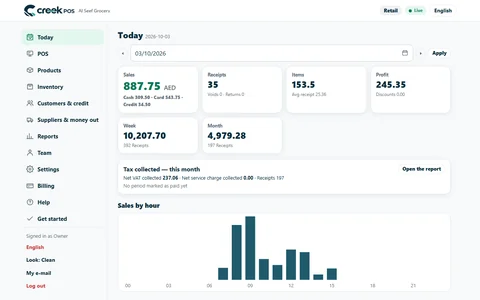
A ten-minute closing routine for a small UAE shop or café: sales, margin, average receipt, the drawer, discounts and stock alerts, in the same order every day.
A shift routine that makes the cash drawer and the card terminal agree with the till every night. Opening float, cash in and out, the Z report and a worked drawer count.
CreekPOS Online free for 14 days, or the program on your PC for 7 days. Every feature, no card.
Search by feature, screen or task. Open a guide and share its link with your team.