

Month-end with your accountant: what to send and when
A month-end pack for a small UAE shop or café: which reports and documents your accountant needs, what to reconcile first, and a timeline that keeps VAT returns calm.
The baqala monthly account keeps regulars loyal, but a notebook loses money. How to set credit rules and limits, record sales and repayments, and collect at month end.
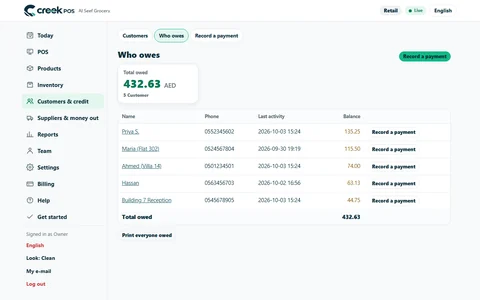
In many UAE neighbourhoods the baqala runs monthly accounts: families, building staff and small offices take what they need and settle when salaries arrive. It is one of the best ways to keep regulars coming back, and one of the easiest ways to lose money quietly. The difference is almost never the customers; it is how the accounts are kept.
The notebook behind the counter works until it does not. Pages get wet or lost, handwriting differs between shifts, and a total written in a hurry is hard to defend when the customer disputes it. Nobody adds up the whole book, so nobody knows how much money is actually outside the shop.
There is also no limit. A notebook will accept a tenth purchase as happily as the first, even when the last payment was two months ago. And when a cashier leaves, part of the memory of who paid what leaves with them.
A short written policy avoids most arguments. Agree it with yourself first, then tell the customer when you open the account:
Limits are the most useful tool you have, because they cap the damage of any single bad debt. The table is an example, not a recommendation.
| Customer type | Example limit | Settles |
|---|---|---|
| New family account | AED 300 | Monthly, after salary day |
| Family with 6+ months on time | AED 800 | Monthly |
| Building staff | AED 200 | Monthly or twice a month |
| Small office | AED 1,500 | Monthly, against a statement |
Think of the total too. Forty accounts averaging AED 600 each is AED 24,000 of your money financing other people's shopping until month end (example, not a statistic). That is stock you have paid for, so decide how much of your cash you are willing to lend.
The rule that saves most disputes: every purchase on account goes through the till at the moment it happens, with the customer selected, and the customer gets a receipt. A receipt that shows the new balance ends most arguments before they start, because the customer sees the running total every visit.
Repayments need the same care. Record the amount, the date and who took the money, and give a receipt. Partial payments are fine; just record them as they happen, not at the end of the day from memory.
Returns from an account customer should go back to the account, not out of the drawer as cash, unless that is what you agreed.
A calm routine works better than chasing:
Look at the age of balances, not just the size. A balance that has not moved for 60 days needs a conversation; one that is large but paid every month is usually fine. People do move away — residents change jobs and flats, sometimes at short notice — which is another reason to keep limits sensible.
Selling on account does not delay the VAT: generally the tax is due on the sale when it happens, not when the customer pays at the end of the month. Your reports should therefore count the sale on the day it was made. Confirm the details with your accountant; the money owed to you is also part of your month-end pack.
Accounts are also the best customer information a small shop has. A monthly view of each regular — what they spent, their balance, their last visit — shows when a good customer suddenly stops coming. That is often a fixable problem: a product you stopped stocking, a delivery that went wrong, a new shop on the corner. A quick word next time you see them is worth more than any campaign.
A sale goes on the customer's account in one tap, and the customer's name and balance print on the receipt. A who-owes-what screen lists every balance; repayments can be full or partial and record the date and who took the money; statements print for each customer. A monthly view shows spend, balance and last visit, returns can go back to the account, and selling on credit is a right you switch on per cashier. Wholesale customers can switch to wholesale prices automatically, and on Platinum or Online, credit payments can also be recorded from a phone. See the customer features.
Should I charge more to account customers? Most baqalas do not; the account is part of the service. Control the cost with limits and prompt collection instead.
What if a customer disputes a balance? Print the statement: each purchase listed with its date usually settles it. This is where the notebook loses.
Can staff open accounts? Better not. Let staff sell on existing accounts within the limit and keep opening and raising limits to the manager.
What about customers who leave without paying? Some loss is part of credit. Limits, phone numbers and quick follow-up keep it small; for larger amounts, ask about the legal options in your emirate.
Want to see the credit screen with real-looking accounts? Open the live grocery demo, or start a 14-day trial and move your notebook in.
This article is general information as of its date, not legal or tax advice. Rules change; check the official source or ask your accountant before acting.

A month-end pack for a small UAE shop or café: which reports and documents your accountant needs, what to reconcile first, and a timeline that keeps VAT returns calm.
What a baqala or minimarket needs from a point of sale, from scanning speed and scale labels to monthly accounts, expiry dates and VAT, plus questions to ask first.
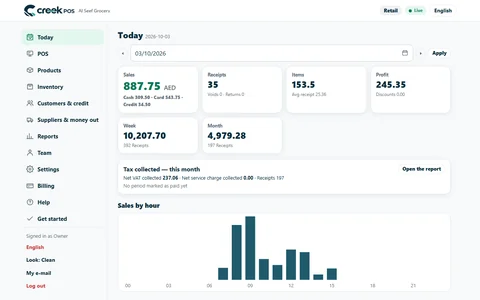
A ten-minute closing routine for a small UAE shop or café: sales, margin, average receipt, the drawer, discounts and stock alerts, in the same order every day.
CreekPOS Online free for 14 days, or the program on your PC for 7 days. Every feature, no card.
Search by feature, screen or task. Open a guide and share its link with your team.