

UAE VAT basics for a small shop — registration, TRN, prices and returns
When a UAE shop must register for VAT, what the TRN is for, how to price with 5% included and how a quarterly return is worked out, explained with plain examples.
A month-end pack for a small UAE shop or café: which reports and documents your accountant needs, what to reconcile first, and a timeline that keeps VAT returns calm.

Many small shops meet their accountant once a quarter, the week the VAT return is due, with a bag of receipts. That is the most expensive way to work: the accountant spends billable hours chasing paper, and mistakes are found when there is no time left to fix them. A short month-end routine, the same pack sent on the same day each month, makes the quarter-end almost boring.
This is general information, not tax advice. Your accountant or tax agent decides what your business needs; use this as a starting list to agree with them.
Most small businesses file VAT returns quarterly through the FTA's EmaraTax portal, some monthly. Either way, the return and payment are due by the 28th day after the end of the tax period. For a quarter ending 31 March, that means 28 April.
Working monthly means each quarter is three small closes instead of one large one. A missing supplier invoice is easy to request three weeks after delivery and hard to find three months later. Monthly figures also give you a real net profit every month, not just a feeling.
| Item | Where it comes from | Why the accountant needs it |
|---|---|---|
| Sales summary by day, with VAT | Till reports or export | Output VAT and revenue |
| Sales split by tax category | Till reports | Standard, zero-rated and exempt sales are reported separately |
| Payment split: cash, card, on account | Till reports | To reconcile with the bank and customer balances |
| Shift closes (Z reports) and drawer differences | Till | Cash control and unexplained differences |
| Full tax invoices issued to companies | Till or invoice copies | Larger B2B sales, customer TRNs |
| Returns and refunds | Till reports | They reduce sales and output VAT |
| Supplier tax invoices | Paper or e-mail from suppliers | Input VAT you may recover, and costs |
| Expenses with their receipts | Your records | Rent, utilities, repairs, salaries |
| Stock value at month end | Stock report or a stock-take | Cost of goods sold and gross profit |
| Customer balances owed to you | Credit accounts report | Money outstanding |
| Amounts you owe suppliers | Supplier balances | What is still to be paid |
| Bank statements | Your bank | The anchor for everything else |
Send the same files in the same format each month. A consistent CSV or PDF pack is easier to check than a different mix every time, and the accountant can compare it with last month at a glance.
Three checks catch most problems before they reach the accountant:
Keep VAT records for at least five years. Corporate tax also applies to UAE businesses for financial years starting on or after 1 June 2023, with a Small Business Relief announced for revenue up to AED 3 million for tax periods ending by 31 December 2026. Whether and how it applies to you, and what to elect, is a question for your accountant — but the same monthly pack is what they will need. For the receipt side of VAT, see simplified vs full tax invoices.
Every report can be exported to CSV for any period, and sales by tax category (standard, zero-rated, exempt) are reported separately. Supplier deliveries, supplier invoices and payments are recorded with what is owed, paid and remaining, expenses feed a net profit figure, and cash in or out of the drawer carries a note. Instead of sending files, you can give your accountant a read-only, token-protected accountant feed. The desktop edition can also drop a daily copy into a folder. See the reports features.
Can I just send everything at the end of the quarter? You can, but it usually costs more in fees and stress, and leaves no time to fix a missing invoice.
Does the accountant need every receipt? Usually not; daily summaries and the export are enough, with individual receipts available if asked. Agree this with them.
What if a supplier is not VAT-registered? Their invoice has no VAT to recover. Record the cost as normal and let your accountant handle it.
Who files the VAT return? You remain responsible, even when your accountant or tax agent prepares and submits it through EmaraTax.
Want to see what a month's export looks like? Open the live demo, or start a 14-day trial and send your accountant a real pack.
This article is general information as of its date, not legal or tax advice. Rules change; check the official source or ask your accountant before acting.

When a UAE shop must register for VAT, what the TRN is for, how to price with 5% included and how a quarterly return is worked out, explained with plain examples.
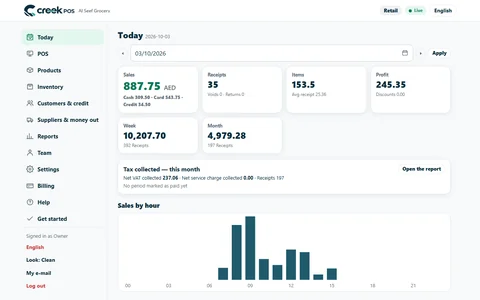
A ten-minute closing routine for a small UAE shop or café: sales, margin, average receipt, the drawer, discounts and stock alerts, in the same order every day.
A retail receipt and a company invoice are not the same document under UAE VAT. Here is what each must show, when the simplified version is allowed, and how a till handles both.
CreekPOS Online free for 14 days, or the program on your PC for 7 days. Every feature, no card.
Search by feature, screen or task. Open a guide and share its link with your team.